For surgery that's less traumatic.
For smaller scars and less pain.
For smaller scars and less pain.
Da Vinci is the answer.
When you learn you need surgery, it's natural to have questions—about the procedure, the recovery, and what to expect.










Ask your doctor if da Vinci surgery is the answer for you.
What is da Vinci surgery —and how could it help?
With da Vinci robotic-assisted surgery, your surgeon operates through small incisions—sometimes as few as one—instead of one large cut. Depending on the procedure, this approach can mean smaller scars, less pain, and a shorter recovery.1-3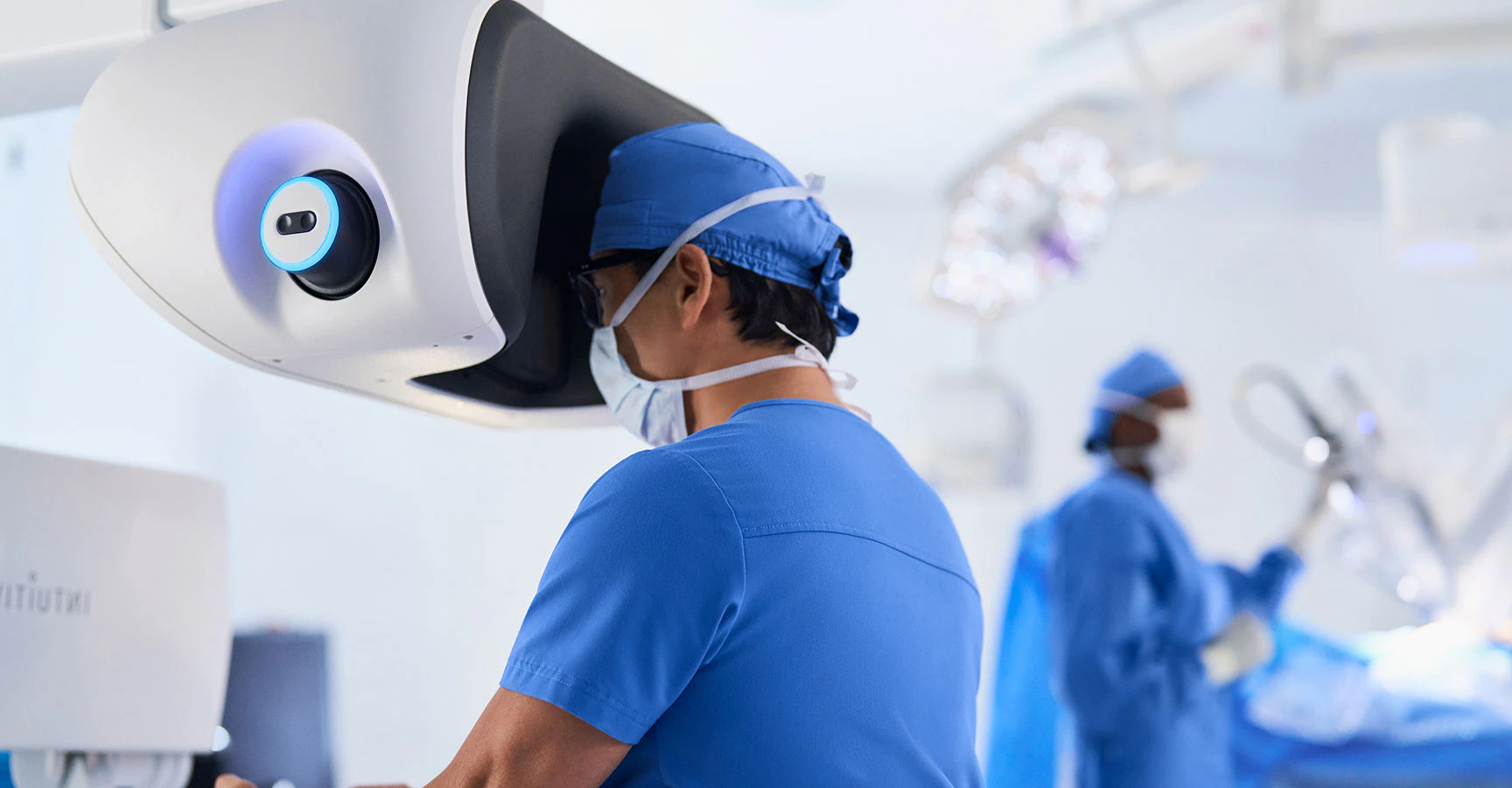
20M+patients have had a da Vinci surgery worldwide
70+procedures available using da Vinci
25+years of surgeons choosing da Vinci
Ready for the next step?
Find a da Vinci surgeon near you
What makes da Vinci different?
Proven, safe and trusted, da Vinci is designed to support gentle surgery and help your surgeon perform a procedure with confidence. Unlike traditional approaches, the system offers a magnified 3D view, instruments that bend and rotate in tight spaces, and built-in steadiness that filters out natural hand tremors—giving your surgeon more control.Published studies have shown that for many procedures:
For noncancerous conditions
Less pain after surgery1,4,6,7
vs. laparoscopic and open surgery
Less pain medication2,4-6
vs. laparoscopic and open surgery
Lower risk of complications1
vs. open surgery; comparable outcomes to laparoscopic surgery
Less time in the hospital1
vs. open surgery; comparable outcomes to laparoscopic surgery
For cancer conditions3
Lower risk of complications after surgery
vs. laparoscopic and open surgery
Reduced chance of a reoperation
vs. open surgery; comparable outcomes to laparascopic surgery
Less time in the hospital
vs. open surgery and laparoscopic surgery
Less risk of readmission to hospital
vs. open surgery and laparoscopic surgery
Open surgery is when the surgeon makes a large incision to access an area directly.
Laparoscopic surgery uses a few small incisions and the surgeon operates thin tools by hand, while an assistant controls a camera.Da Vinci surgery is safe and effective for performing certain procedures when used appropriately and with proper training.8 These are common results for many procedures. Individual outcomes may depend on a number of factors—including, but not limited to—patient characteristics, disease characteristics, and/or surgeon experience
Laparoscopic surgery uses a few small incisions and the surgeon operates thin tools by hand, while an assistant controls a camera.Da Vinci surgery is safe and effective for performing certain procedures when used appropriately and with proper training.8 These are common results for many procedures. Individual outcomes may depend on a number of factors—including, but not limited to—patient characteristics, disease characteristics, and/or surgeon experience
You have questions.
We have answers.
Why should you consider da Vinci surgery?
Is da Vinci surgery safe?
Does the robot perform the surgery?
How much does da Vinci cost?
What should I ask my doctor?


Is da Vinci right for your procedure?
In the U.S., da Vinci surgery is used for over 70 procedures across several specialties such as urology, gynecology, general surgery, and more.Da Vinci surgery is usually covered by insurance in the U.S., but coverage can vary. If your doctor recommends da Vinci, check with your insurance company to understand if your procedure is covered.
Many da Vinci surgeons track their patient outcomes and are willing to share them with patients. Use our locator to find a surgeon near you—and ask about their experience with your procedure.
Many da Vinci surgeons track their patient outcomes and are willing to share them with patients. Use our locator to find a surgeon near you—and ask about their experience with your procedure.